University of Waikato, 2012 to 2022
From 2012 to 2022 I established and led the Waikato Environmental Geochemistry (WEG) research group at the University of Waikato. Its work covered cave palaeoclimate, aqueous biogeochemistry, soil contaminant dynamics and isotope geochemistry. The group hosted researchers from four continents and was supported by over $14 million in competitive funding.
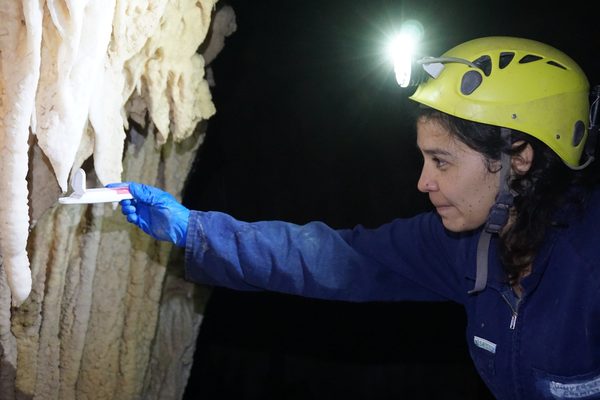
Developing speleothem proxies from colloidal geochemistry, using organic ligand and metal interactions that carry information about infiltration, vegetation and temperature. This work sat at the centre of the EU QUEST network and the Rutherford Discovery Fellowship.
Natural ligands and nanoparticles controlling metal mobility and bioavailability in lakes and rivers. Includes studies of phosphorus–iron nanoparticle interactions under variable redox conditions and alum dosing for P-sequestration.
Diffusive gradients in thin films for speciation and biogeochemical availability of metals, nutrients, and contaminants in natural and polluted aquatic environments.
Fate, mobility, and transformation of toxic metals (Cd), pollutants, and nutrients at the soil–water–root interface. Cadmium isotope tracing from fertiliser through soil to aquatic ecosystems.
Stable (O, C) and exotic isotopes (δ¹¹⁴Cd, δ⁶⁵Cu) applied to modern and ancient processes, through collaborations with Melbourne, Otago, and Wollongong isotope labs.
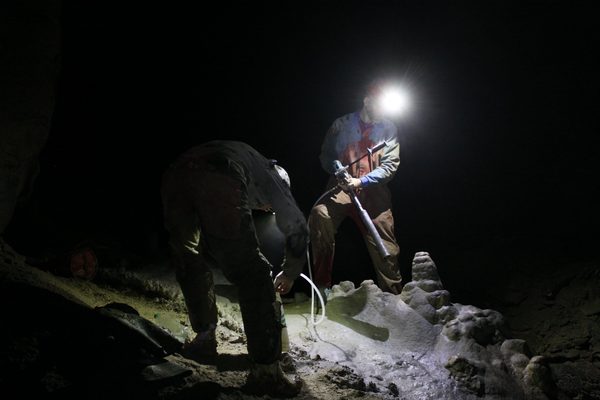
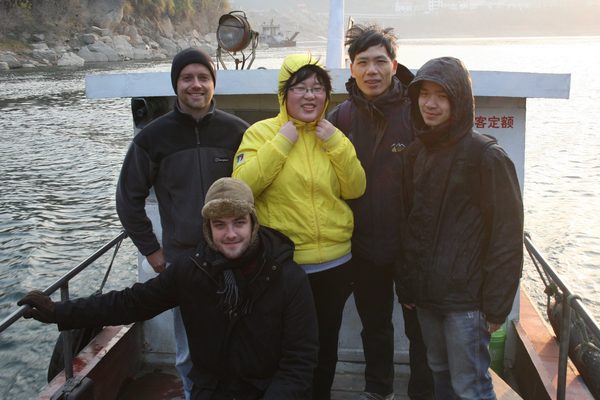
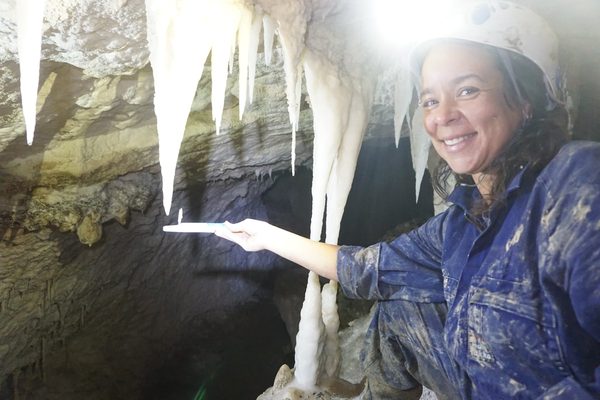
WEG fieldwork ran from the Waitomo karst on our doorstep to raised coral atolls in the South Pacific, with monitoring campaigns in China and Scotland through the QUEST and SCENT projects.
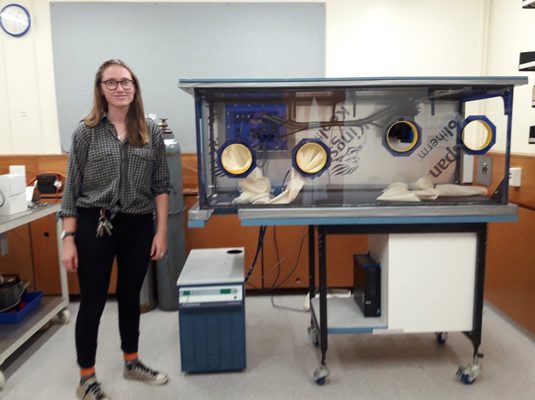
A friendly, busy and productive lab, run throughout by Dr Amanda French. The instrument set was built up to let us take a water, soil or mineral sample from collection through to trace element and organic matter characterisation without leaving the building.
Agilent 8900 triple-quadrupole ICP-MS, fed by an ASI 193 nm excimer laser for ablation, by HPLC for speciation, or by solution.
Horiba Aqualog fluorescence spectrometer for 3D excitation-emission matrices, and an OI Analytical analyser for organic and inorganic carbon.
Size-exclusion and reversed-phase HPLC, field-flow fractionation, and ultrafiltration for separating dissolved from colloidal fractions.
Dionex ICS-2000 ion chromatograph.
Savillex DST-1000 sub-boiling still, installed in 2015, producing acids pure enough for parts-per-trillion work.
Isotope ratio mass spectrometry, cavity ring-down spectroscopy, GC-MS, and diffusive gradients in thin films, with partner labs in Melbourne, Otago and Wollongong.
Over a decade, WEG trained researchers who have gone on to positions in academia, government science and industry. Most projects were collaborative, and many of the people below remain collaborators.
Developing a new speleothem hydroclimate proxy based on trace metal–organic ligand interactions in dripwater. Cave monitoring in NZ and South Pacific, with carbonate growth experiments.
Enhancing phosphorus removal from agricultural subsurface drainage by activated bio-media. Joint supervision with NIWA (Rupert Craggs) and Massey (Dorisel Torres-Rojas).
The terrestrial carbon cycle in transition: tracking changes using novel tracers on multiple timescales. Marsden Fund supported.
Speleothem records of Pacific hydroclimate. Joint with Ruhr-Universität Bochum through QUEST.
Assessing the leaching potential of cadmium across gradients of soil type and land use. MBIE-funded cadmium isotope programme.
Redox cycling of macro and micro-nutrients in a monomictic lake.
Quantification of nitrate concentrations and flow rates in freshwater: enhancement of the DGT methodology.
Effects of organic matter complexation on partitioning of transition metals into calcite, using cave-analogue crystal growth studies.
Biogeochemical characterisation of an alum-dosed stream: implications for phosphate cycling in Lake Rotoehu.
Quantifying condensation corrosion in the Glowworm Cave, Waitomo.
Chris Wood (2020 to 2022), Mahdiyeh Salmanzadeh (2018 to 2020)
Ben Scarlet (2014), Jain Abraham (2015), Amy Shen (2016), Jackson White (2016), Katie O'Reilly (2017), Pierre Oesterle (2013, international intern), Katrin Hattig (2018, PROMOS, Bremen)
WEG was supported by over $14 million in competitive research funding (as PI or associate investigator) from New Zealand, Australian, and European agencies.
MBIE Endeavour Fund, $1,000,000, PI
Australian Synchrotron Beamtime, $65,568 AUD in-kind
Australian Synchrotron Beamtime, $65,568 AUD in-kind
MBIE Endeavour Fund, $8,000,000, Associate Investigator (PI: Chris Tanner, NIWA)
MBIE Endeavour Fund, $999,808, PI
Rutherford Discovery Fellowship (Royal Society Te Apārangi), $800,000
MBIE Smart Ideas, $999,822, Associate Investigator (PI: Joel Baker, Auckland)
EU Horizon 2020 Marie Skłodowska-Curie RISE, €400,000, NZ PI
MBIE Smart Ideas, $999,960, Associate Investigator (PIs: Cary & Pilditch)
Marsden Fast-Start (Royal Society Te Apārangi), $300,000, PI
Fertiliser Association of NZ, $22,500
Australian Institute of Nuclear Science & Engineering, $22,000 AUD
As climate and environmental scientists, we were conscious of the impact of our own research. Fieldwork and conferences mean flying, and flying means emissions. From 2019 the group worked to two rules:
Not flying at all was not realistic for the work, and early-career researchers need the exposure that travel brings. Alongside this we reused and repurposed lab consumables where we could, and used the University's electric vehicles for local trips.
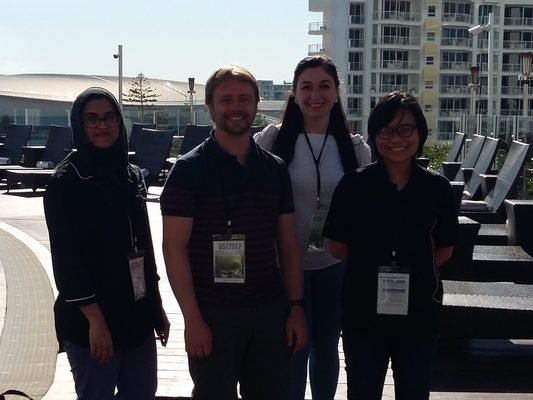
Through the EU QUEST programme and bilateral exchanges, WEG hosted over 20 international researchers from institutions in Europe, Australia, the US and Asia. Many of those connections are still active.
Martin Andersen, UNSW, Australia (2014)
John Hellstrom, University of Melbourne (2015, 2019)
Chaoyong Hu, China University of Geosciences (2016)
Niklas Lehto, Lincoln University (2016)
Sebastian Breitenbach, Ruhr-Universität Bochum (2016, 2018–19)
Tihana Vujinovic, Lincoln University (2017)
Dharshika Welikala, Lincoln University (2017)
Mirona Chirienco, OIST, Okinawa (2017)
Andreas Holbach, KIT, Karlsruhe (2017)
Ry Farley, Vassar College, New York (2017)
Inken Heidke, JGU Mainz (2017–18)
David Dominguez-Villar, Ruđer Bošković Institute, Zagreb (2018)
Maximilian Hansen, JGU Mainz (2018)
Bedartha Goswami, PIK Potsdam (2018)
Hauke Kraemer, PIK Potsdam (2018)
Ola Kwiecien, Ruhr-Universität Bochum (2018–19)
Cinthya Nava Fernandez, Ruhr-Universität Bochum (2019)
Anja Beschnitt, JGU Mainz (2019)
Marco Roth, Ruhr-Universität Bochum (2019)
Alena Giesche, University of Cambridge (2019)
Sebastian Breitenbach (September 2016), Speleothems reveal a 500,000 year history of Siberian permafrost
Mirona Chirienco (June 2017), Climate variability during MIS3 recorded by two stalagmites from Donnehue's Cave, midwestern USA
John Hellstrom (April 2019), Structure from motion for photogrammetric mapping of caves
The group kept a blog for most of its run, written by whoever had just come back from the field. The posts are still online at the original WordPress site and are listed here so they stay findable.